

bkg-interne

Digital Solutions

Marketing Automation

Marketing automation turns digital interactions into journeys aligned with commercial objectives. It makes it possible to manage and qualify leads and guide them towards a useful action.

It connects data, content and touchpoints, reduces manual work and sends messages in line with the user’s behaviour, interest and stage in the journey.
Why invest in marketing automation?

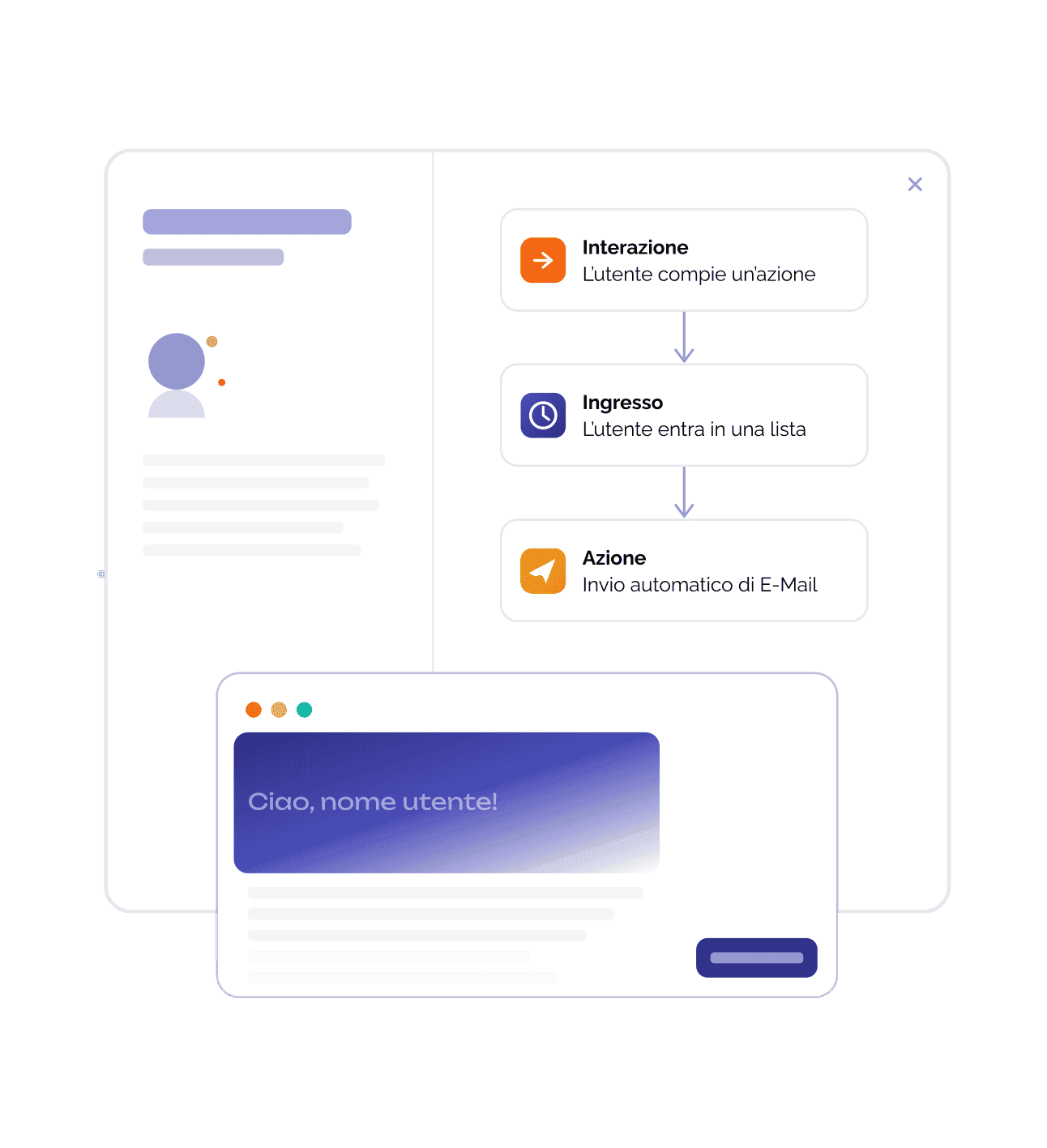
Marketing automation helps manage the relationship between a company and its audience more effectively, turning signals such as completed forms, downloads and campaign interactions into useful information.

Through automated workflows, dynamic segmentation and personalised content, we build differentiated journeys based on the behaviour and the maturity of each contact.

What are the benefits of marketing automation?

An effective marketing automation strategy allows you to achieve:

The main value is not operational automation alone.

It is the ability to make the whole process of acquisition and retention more solid: less waste, more control over the data, greater consistency between marketing and sales.

Marketing automation vs email marketing

Marketing automation and email marketing are often confused, but they are not the same thing.

Email marketing focuses on sending communications to a list of contacts: newsletters, promotions, periodic updates. Marketing automation, by contrast, builds journeys based on user behaviour. Visiting a page, opening an email, completing a form, abandoning a basket, a previous purchase: every action becomes a trigger.

The difference lies in the depth of the strategy: on one side the sending of messages, on the other a relationship system based on data, triggers and objectives.

The key factors in an effective strategy

A marketing automation strategy only works if it is designed methodically. Automating weak processes does not make them more effective: it only makes them faster. That is why we always start from an analysis of the user journey, of the commercial objectives and of the quality of the data available.

Mapping the customer journey

Before building a workflow, we analyse the user journey. We identify the main touchpoints, the decision-making stages, the content already available and the points where contacts tend to stall or drift away. This lets us see where automation can generate real value.

Segmenting contacts

Not all contacts have the same value, the same level of awareness or the same urgency. We build segments based on demographic, behavioural and commercial data. In this way we adapt messages and priorities, reducing waste.

Lead nurturing and lead scoring

Lead nurturing cultivates contacts over time with progressive content. Lead scoring classifies leads according to their level of interest. In this way the sales team concentrates on the best-qualified contacts, rather than treating mature opportunities and still-cold contacts in the same way.

Automated content and messages

Every automation needs consistent content. Emails, landing pages, post-form messages, downloadable content and reminders are built around the user’s need and the point they have reached in the journey. An effective flow does not bombard the contact: it accompanies them with clear, useful, action-oriented messages.

Tracking and data quality

Data quality is decisive. If forms, CRM, advertising platforms, the site and email marketing tools do not communicate properly, the automation loses its effectiveness. We check that events are tracked, that lists are clean, that consent is handled correctly and that the integrations allow a reliable reading of user behaviour.

How we approach marketing automation

Our work starts from the strategy. Before choosing tools, workflows or automations, we analyse the business model, the user journey, the commercial objectives and the quality of the data available. The aim is to build a system that concretely supports the growth of the relationship between the company and its contacts, not one that merely sends automatic communications.

We assess the business model, the sales cycle, the acquisition channels, the quality of the leads and the tools already in use. This stage serves to distinguish what can be automated straight away from what first requires a review of the process or of the content.

We define the strategic structure of the flows, building workflows designed for specific objectives: welcoming a new lead, nurturing a contact after an enquiry, winning back inactive users, encouraging a second purchase, supporting the sales team or improving after-sales management. Every flow is designed with clear logic, entry conditions, subsequent actions and evaluation metrics.

We develop the text and content the flows require, keeping them consistent with the brand’s tone of voice. Every message has a precise function: to inform, qualify, reassure, reactivate or guide towards conversion. Copy is not decorative: it is an integral part of performance.

After activation, we analyse opens, clicks, conversions, response times, lead quality and progress through the flows. Automations should not stand still: they need to be tested, corrected and improved on the basis of the data gathered.

They have chosen us

Frequently asked questions

No. Emails are often an important part of the process, but marketing automation also covers segmentation, workflows, lead scoring, CRM integrations, data management, event tracking and personalised communications across several touchpoints.

Not always, but having a CRM or a well-organised tool makes the work more effective. If the current system is fragmented, we begin with a stage of analysis and tidying up of the data before building advanced flows. It is not a blocking prerequisite: it is a variable we take into account in the design.

It depends on the volume of contacts, on the quality of the database and on the objectives. The first signs can be read from the initial interactions, but a full assessment requires enough data on opens, clicks, conversions and the progress of leads through the journey.

Yes, if the database is qualified and the sales process needs more order. With low volumes, though, it is important not to build oversized systems. In these cases we design flows that are essential and scalable: they grow with the database, without wasting resources in the early stages.

Still have questions?

Contact our experts for further details

Contact

    * Required fields