

bkg-interne

Data & Analytics

Google Consent Mode V2

Since March 2024, Google Consent Mode V2 has been mandatory for companies using Google advertising and analytics tools with users in the European Economic Area. An implementation that is missing or incorrect can reduce data quality and increase the risk of privacy non-compliance.
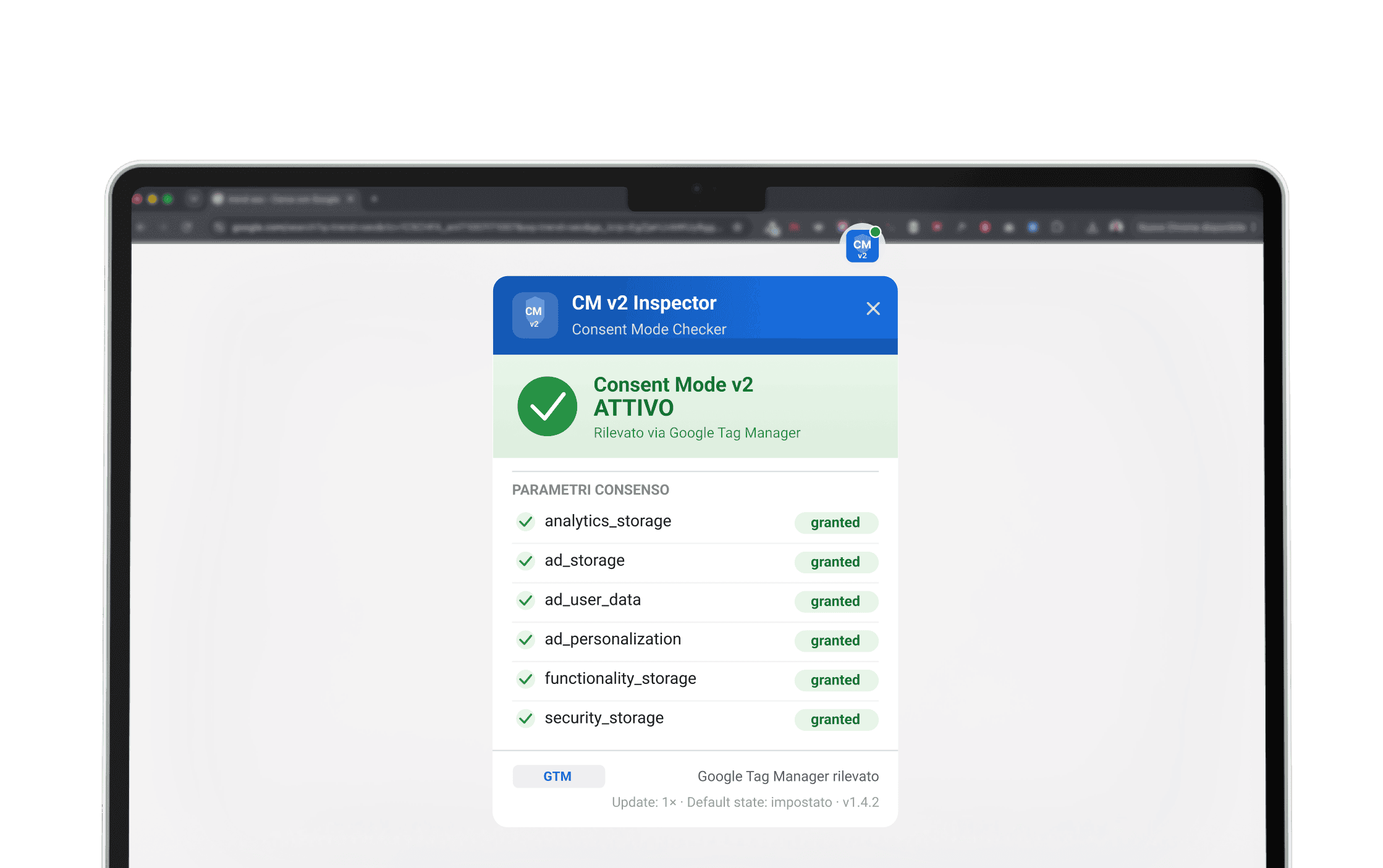
Configuring Consent Mode V2 for consent and tracking

A professional configuration guarantees consent management that complies with privacy legislation, along with accurate conversion tracking.

With an advanced configuration, when consent is refused Google can still receive anonymous, aggregated signals, with no advertising cookies, which are useful for estimating the missing conversions and reducing data loss in advertising campaigns.

What is Google Consent Mode V2 and how does it work?

Consent Mode V2 is the system Google developed to manage the tracking of user data by advertisers operating in the European Economic Area.

Following the entry into force of the Digital Markets Act in March 2024, it became a mandatory requirement for advertisers using Google tools for advertising and marketing purposes.

When a user lands on a site, they express their privacy preferences through the cookie banner. If they accept, the data is collected and used to optimise campaigns and improve targeting. If they refuse, the signals available are reduced and the loss of data can be considerable.

To prevent advertisers from losing too much data, Google introduced conversion modelling. Using AI, the behaviour of users who accepted cookies is analysed and the behaviour of those who refused is estimated. Only a professional, advanced implementation gives access to these predictive models while remaining compliant with the legislation.

Google Consent Mode V2: Basic vs Advanced

There are two types of configuration, depending on how consent is handled: basic and advanced.

BasicAdvanced
Google tagsTags are blocked until the user interacts with the cookie bannerTags load immediately but adapt according to consent
Before consentNo data is sentCookieless signals and consent state are sent
If the user refuses everythingTags do not fire and no data is recordedCookieless data is sent
If the user accepts everythingTags fire and full data is sent in line with the consent granted.Tags fire and full data is sent in line with the consent granted.
The user refuses one or more purposesTags linked to the refused purposes do not fire.For the items the user has refused, only cookieless signals are sent
Conversion modellingGeneral, not very detailedSpecific to the advertiser, more detailed
ImplementationEasy to implement and maintainMore complex to implement, but higher-performing
BenefitsA straightforward way to stay compliant, but with a substantial loss of dataDetailed tracking and optimisation

In short: with basic mode, users who refuse cookies are not tracked in any form. With advanced mode, aggregated and anonymous signals are sent instead. These signals make it possible to model and optimise campaigns without breaching either the user’s preferences or the legislation in force.

Why does a correct configuration matter?

Implementing Google Consent Mode V2 makes it possible to manage consent in a compliant way, to make campaign data more reliable and to improve performance.
The main benefits of implementation are:

Greater accuracy in campaign measurement

A correct configuration distinguishes between the different consent scenarios, giving a more accurate measurement of interactions and conversions.

Support for conversion modelling

When consent is not granted, cookieless signals reduce the loss of information in reports. More signals available means better-performing campaigns and a return on investment optimised on the basis of concrete data.

Continuity of retargeting and personalisation

When consent is granted, these activities continue to work correctly, in line with the user’s preferences.

Regulatory compliance

An incorrect configuration can compromise the proper handling of consent and increase the risk of non-compliance with European privacy legislation. Implementing it correctly protects the company and allows user data to be handled responsibly.

Why work with an agency to configure Consent Mode V2?

An incorrect implementation can produce attribution errors, data loss, non-compliant collection and undersized remarketing audiences.

The real problem is not configuring the tracking: it is noticing quickly when the measurements stop working.

Working with an agency that specialises in digital advertising brings a cross-cutting view built up across a range of projects. This makes it possible to anticipate difficulties and prevent the most common errors. The result is more reliable data, more efficient campaigns and the certainty of staying compliant, without having to keep track of a technical subject that is constantly evolving.

Our process for configuring Consent Mode V2

We carry out a professional implementation of the solution, to support consent management that complies with the legislation, with precise tracking and reliable data.

To set up Consent Mode V2, a cookie banner and a consent management solution are required. The latter can be built into a CMP (Consent Management Platform) or developed bespoke.

If a CMP is chosen, Consent Mode V2 can be configured either through a plugin or through Google Tag Manager. The plugin is a simple but less flexible option. Manual configuration through Google Tag Manager (GTM) requires specific technical skills, but offers greater control over every consent parameter. This configuration allows greater control over the consent parameters and makes it possible to use advanced mode.

Except in specific cases, we prefer manual configuration through GTM, for more granular control over every parameter. We set the default state of the consent parameters — ad_storage, analytics_storage, ad_user_data and ad_personalization — to “denied”, so that the tags collect no data before the user interacts with the cookie banner. We then adjust the firing settings of the tracking tags so that they respect the consent choices the user has expressed.

Once the configuration is complete, we carry out thorough checks to verify that the tags behave correctly in every possible scenario: full consent, full refusal and partial consent.

They have chosen us

We work with national and international companies, B2B and B2C brands, e-commerce businesses and public sector organisations that want to improve their data tracking in order to run better-performing advertising campaigns.

Frequently asked questions

Google Consent Mode V2 is the system Google developed to manage the tracking of user data in line with those users’ preferences. It governs the behaviour of Google tools according to the consent received, allowing companies to continue measuring the performance of their advertising campaigns in a way that complies with European privacy legislation.

The tools for which Google Consent Mode V2 must be implemented are all those forming part of the Google ecosystem, namely:

  • Google Analytics 4 (where it is used for advertising and retargeting purposes)
  • Google Ads
  • Google AdSense
  • Floodlight
  • Conversion linker

No; Google Consent Mode V2 is specific to Google products — Analytics 4, Google Ads, Floodlight — and does not apply to other tracking tools. However, if the user refuses consent, the Meta Ads Pixel must not fire, under the GDPR. It is therefore necessary to check that the handling of user preferences is correctly configured for those tools as well.

No; the cookie banner remains essential in order to collect the user’s choices. Consent Mode V2 defines how the data is processed on the basis of those choices, ensuring tracking that is compliant and respectful of users’ preferences.

Still Have Questions?

Contact our experts for further details

Contact

    * Required fields