SEO
Keyword research
To rank a website in search engines you first need to understand how people search. That means identifying the terms they use, the intent behind each search and how it relates to the needs they are expressing.



SEO
To rank a website in search engines you first need to understand how people search. That means identifying the terms they use, the intent behind each search and how it relates to the needs they are expressing.
Keyword analysis is the research and study of the language with which users express their needs. It applies to searches for products, services or information relating to a specific sector.
From this analysis we build a strategic map that guides the service pages, articles, categories and editorial priorities of the site. The aim is to cover the relevant keywords as effectively as possible and to identify the opportunities that are not yet being captured.
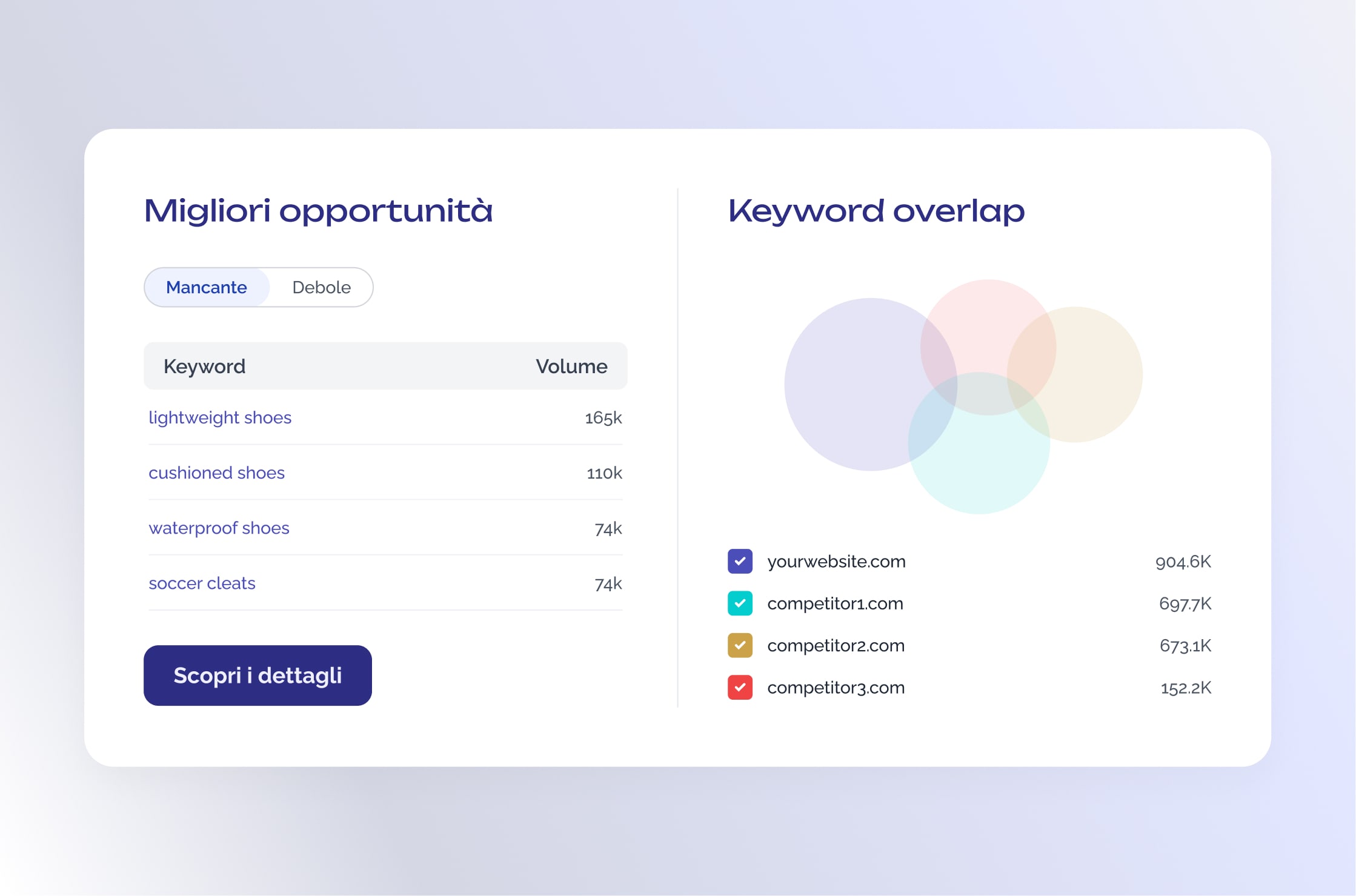
Keyword research is the starting point of a structured SEO strategy. It answers concrete questions about your market:

What are your potential customers looking for?

What language do they use to describe needs, problems or doubts?

Where are they in the conversion journey?

Where can you stand out from your competitors?

How can you expand your business?
Working from real data, keyword research makes it possible to identify new areas of growth and to steer content production strategically. It underpins semantic SEO, through which a site can improve its rankings for strategic keywords and widen its audience.
Every online search reflects an intention. “Best tennis shoes” indicates a comparative, pre-purchase stage. “Cheapest tennis shoes” signals that a decision is close, but with different priorities as regards quality.
Search intent is the intention behind the keywords used. Understanding it makes it possible to reach the right audience at the most opportune moment.
Search volume indicates how many people use a given keyword over a specific period. Keywords with high volumes tend to have vague intent and to be difficult to rank for.
An effective strategy also knows how to recognise niche terms. They have lower volumes, but they reach users with a more clearly defined and better qualified intention.
Keywords do not exist in isolation. We group them by subject in order to build a complete semantic map and a coherent site architecture, which search engines recognise as authoritative.
Clustering also makes it possible to enrich the text with the real language of users and to reach different audiences.
In advanced keyword research, competitor analysis is a central step. Knowing which keywords they rank for, which ones we cover and which are still uncontested gives a concrete map of opportunities. A thorough strategic analysis allows us to widen our own rankings by drawing on competitors’ strategies.

The starting point is listening to the client. We analyse objectives, competitive context and market scope. This step is necessary in order to set the positioning appropriately, avoiding comparisons with organic competitors that are not commercially relevant.

We build a map of the site’s thematic areas, with main subjects, sub-topics and semantic connections. From this basis we work on individual topics in order to widen the language of the site and the commercial opportunities.

We classify every keyword identified by search intent, volume, competitiveness and relevance to the objectives. The result is an ordered list of opportunities, with clear guidance on where to act first and why.

We deliver a structured, readable document in which we explain the choices and the entries, so that the work is comprehensible to the whole team. When keyword research is the first step in a broader strategy, this document becomes its operational guide.
We have worked on the structure of semantic SEO strategies in a variety of settings. We have supported established companies operating across several locations or in local markets, with differing needs in terms of visibility, consistency and performance.












It depends on the size of the site, on how complex the sector is and on the objectives. For a medium-sized project, the analysis generally takes 20 to 30 days. We agree delivery times before work begins, with a shared Gantt chart that guarantees an orderly and punctual schedule.
Yes; we work in several languages thanks to native-speaker collaborators based in a number of countries. For international or multilingual projects, this allows us to work with the real language of local users rather than with approximate translations.
No, it is a starting point rather than a destination. To achieve concrete results in search engine visibility, content production and an SEO audit of the site structure are also needed. Without keyword research, though, it is difficult to optimise in any structured way.
Yes, we recommend it. Users’ language evolves over time. Updating the analysis keeps rankings aligned with current searches, avoiding coverage of terms that no longer reflect the audience’s habits.
Contact our experts for further details
Get in touch to define the most suitable path together. We analyse the starting context and identify the strategy geared to your objectives.