bkg-interne

Performance Audit

Google Ads

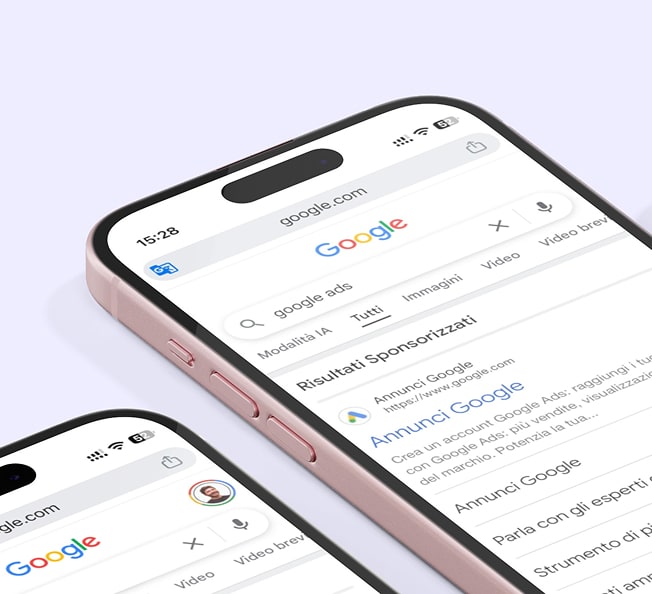
Google Ads puts you in front of people at the exact moment they are searching for a specific product or service. We design targeted campaigns that generate leads, sales and commercial opportunities, while cutting out unqualified clicks and wasted budget.

Why invest in Google Ads?

Google Ads is the best tool for capturing demand that already exists. When someone searches for a specific product or service, they are often well into their decision-making process. Being there at that moment means getting into the shortlist before your competitors do.

Delivering results, though, takes accurate keyword research, ads that match search intent, and landing pages that turn a click into a measurable action. A well-built strategy reduces waste, makes the investment work harder and scales what is already working.

google ads

Google Ads vs social media advertising: which should you choose?

Google Ads and social media advertising follow different logics. They are not alternatives — they are complementary.

Google AdsSocial Media Ads
Type of demandActive: the user is already searchingLatent: the user is not actively searching
Targeting logicKeywords and search intentInterests, behaviours, professional profiles
Stage of the journeyClose to conversionAttention and shaping the decision journey
Primary objectiveReach people who are ready to convertBuild demand and brand recognition

In many cases, the most effective strategy combines both channels. Google Ads covers the search and conversion stage. Social channels build attention, feed the decision-making process and strengthen brand recognition. The aim is not to pick the “better” channel, but to build an ecosystem that fits the market, the budget and the business objectives.

Google Ads campaigns for different goals

Google Ads can support a range of objectives, but each one calls for a specific set-up.

For lead generation, we work on high-intent keywords, ads geared towards enquiries, and landing pages designed to make the form easy to complete. For e-commerce, the priorities become feed quality, the structure of Shopping or Performance Max campaigns, conversion value tracking and ROAS management.

For local businesses, Google Ads reaches users in precise geographic areas, making the most of calls, directions, quote requests and store visits. For established brands, campaigns protect branded searches and defend strategic queries against direct competitors.

The point is to choose the campaign type to suit the objective, not the other way round.

What makes a Google Ads campaign work

An effective Google Ads campaign comes from combining technical, strategic and creative elements. It needs a structure the algorithm can work with, reliable data, and traffic that is genuinely useful to the business.

01 / 05

Keyword research and search intent

We analyse user searches, distinguishing between informational, commercial and transactional queries, to identify the most relevant keywords. We favour searches that bring in qualified users, balancing volume, precision and conversion potential.

02 / 05

Campaign structure

We organise campaigns and ad groups around objectives, services and commercial priorities. We avoid structures that are too fragmented, which slow down the learning phase, as well as set-ups that are too broad, which make results hard to read.

03 / 05

Ads and ad copy

We write clear ads that match the user’s search intent. The aim is not simply to increase clicks, but to attract qualified traffic, make the offer count and drive a concrete action.

04 / 05

Landing pages and a consistent journey

We assess destination pages for content clarity, presence of CTAs, mobile usability and consistency with keywords and ads. A weak landing page can reduce conversions and drain the budget.

05 / 05

Tracking and measurement

We check the configuration of conversions, events, Google Tag Manager, Google Analytics and Consent Mode. Reliable tracking makes it possible to measure the actions that matter and identify the campaigns, keywords and changes that create value.

How we work on Google Ads

Our method starts with understanding the context. Before launching or changing a campaign, we study the business, the market, the competitors, the audience and the objectives. This tells us what role Google Ads should play in the wider strategy and what results are realistic to expect.

We review the website, the offering, the destination pages, the brand’s positioning and any campaigns already running. We identify issues, opportunities and priorities through an internal audit, avoiding quick fixes on elements that need to be read in a wider context.

We define the campaign structure, the budget split, the keywords to cover, the segments to exclude, the conversion goals and the KPIs to monitor. Planning is not based on off-the-shelf templates, but on the business model and the real margin behind the actions we want to drive.

We configure every campaign type available on the platform: Search, Performance Max, Display, Demand Gen, Shopping, App and YouTube. Each choice is judged on what it can realistically deliver: leads, sales, reach, calls, qualified traffic, app downloads or funnel support.

Once campaigns are live, the work continues. We monitor search queries, cost per conversion, conversion rate, traffic quality, assets, ads, audience segments and budget distribution. We step in with tests and incremental optimisations to improve the efficiency of the investment and reduce waste.

We share reports built around the metrics that matter. We do not stop at clicks, impressions and CTR: we look at the relationship between spend and results, the value of the conversions generated, and what needs to happen to improve performance in the months ahead.

Our Clients

Google Ads: frequently asked questions

There is no single right budget. It depends on the sector, how competitive the keywords are, the geographic area, the average value of a conversion and the objectives. A budget that is too low never gathers enough data to be useful. A large budget without a strategy simply creates waste. That is why we set the investment starting from a realistic estimate of clicks, conversions and cost per acquisition.

The first signals come through within the first few weeks, so there is no need to wait months to know whether the direction is right. That initial period is about identifying which keywords, ads and segments are showing positive signals. From there, we optimise step by step to improve traffic quality and cost per conversion over time.

It works where there is existing demand to capture, or where the channel is properly built into a wider strategy. If nobody is actively searching for that product or service, search campaigns on their own may not be enough. In that case, we add awareness channels to build the demand before capturing it.

In most cases, yes. A dedicated landing page improves consistency between the search, the ad and the page content, which can increase conversion rate and make the budget go further. If the site already has strong pages, we can start from those. If the journey is weak, the landing page becomes a priority before the campaigns even go live.

Still have questions?

Contact our experts for further details

Contact

Contact us to define the most suitable approach together.
We analyse the starting context and identify the strategy that best aligns with your objectives.

    * Required fields